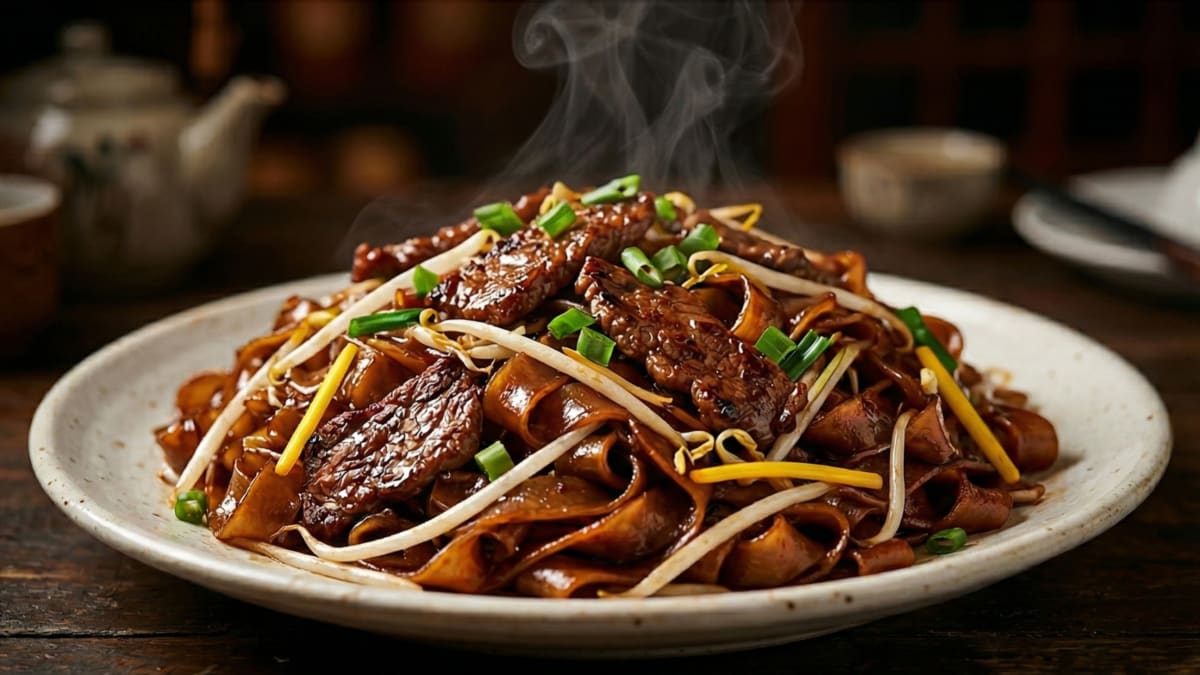
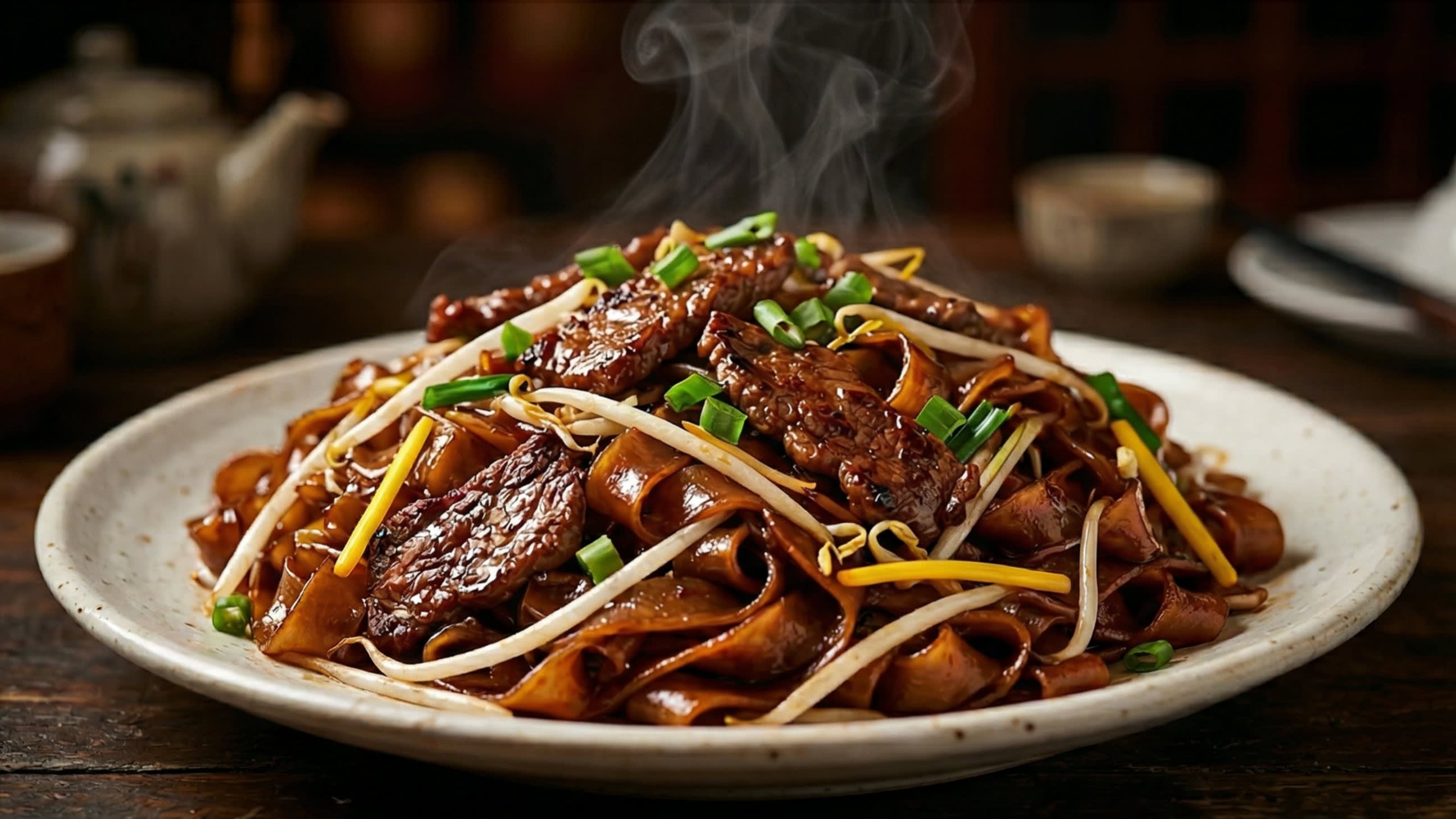
🥢 Introduction: The Ultimate Test of a Cantonese Chef
In the high-octane world of traditional Cantonese culinary arts, there is a legendary benchmark: “If you want to test the true skill of a wok chef, do not ask them to cook an expensive abalone or lobster. Ask them to make a plate of Beef Chow Fun.”
Beef Chow Fun (干炒牛河 - Gān chǎo niú hé) is the undisputed holy grail of Chinese stir-fried noodles. Walk into any midnight Dai Pai Dong (open-air food stall) in the bustling streets of Guangzhou or the neon-lit lanes of Hong Kong, and you will immediately be hit by a sensory overload. You will hear the rhythmic, aggressive clanging of carbon steel woks and smell the intoxicating, smoky aroma of soy sauce caramelizing upon contact with roaring, high-intensity flames.
When executed with mastery, this dish is a textural symphony. The wide rice noodles are remarkably springy and slippery, coated in a savory, dark mahogany glaze without a single drop of excess liquid pooling on the plate. The beef is transformed into velvet-soft ribbons, while the fresh bean sprouts provide a necessary, watery, loud crunch. Above all, the entire composition must be infused with Guōqì (锅气 - Wok Hei)—the legendary “breath of the wok,” a complex, smoky, almost charred essence that is the hallmark of professional stir-fry technique.
However, for home cooks—especially those who have only encountered the often-greasy, broken-noodle version served in Western takeout shops—this dish feels like an impossible puzzle. If you have ever tried recreating it, you likely ended up with a tragic, gloopy pile of mushy rice fragments glued to the bottom of your pan. Today, I am going to demystify the science of the wok. We are going to explore how to handle those fragile, high-maintenance rice noodles, the importance of “dry-frying,” and how to capture that elusive, restaurant-quality smokiness in your own home kitchen.
If you enjoy the precision of high-heat cooking, you might also want to try mastering the Authentic Beef Chow Fun (Gon Chau Ngau Ho): Master the Wok Hei Secret or exploring the smoky depths of Authentic Chinese Chow Mein: The Ultimate 15-Minute Noodle Recipe.
🔬 The Anatomy of the Dish: What is “Gon Chau”?
To truly command this dish, you must understand the terminology. The Chinese name Gān chǎo niú hé translates literally to “Dry-fried beef rice noodles.”
- Hé (河): Short for Héfěn (河粉), the wide, flat, fresh rice noodles that form the soul of the dish.
- Niú (牛): The tender, velveted beef slices.
- Gān chǎo (干炒 - Dry Fry): This is the heart of the technique. Unlike “Wet-fried” dishes (湿炒) which are often hidden under a thick, cornstarch-laden gravy, a “Dry Fry” uses absolutely zero added water or broth. The noodles are aggressively seared in a thin coating of oil, allowing the soy sauce to rapidly evaporate and create a deep, caramelized crust on the noodle surface. The final result should be entirely dry, glistening, and packed with concentrated flavor.
🥡 The Noodle Dilemma: Avoiding the Broken Mess
The biggest hurdle for home cooks is the rice noodle itself. Fresh Héfěn (河粉) is a fragile, temperamental ingredient. If you buy a pack from your local Asian grocer and store it in the refrigerator, the cold temperature causes the starches to firm up into a solid, brittle brick.
The Pro Secret (The Microwave Revival): If you try to peel apart cold, refrigerated rice noodles, they will instantly shatter into hundreds of tiny, unusable fragments. The restaurant hack? Simply place the sealed package in the microwave for 30 to 45 seconds. The gentle microwave heat softens the starches, restoring them to their pliable, freshly-steamed state. Once warmed, lightly oil your hands and gently peel the long noodle strands apart before they ever touch the wok.
(If you absolutely cannot find fresh noodles, wide dried rice noodles are a substitute, but be careful. Soak them in warm water until they are just pliable—never boil them until soft, or they will turn to mush during the high-heat toss.)
🔥 The “Run Guo” Technique: Stopping the Stick
Rice noodles are essentially pure starch, and they possess an uncanny ability to bond with metal the second they hit the pan. To stop your noodles from sticking and tearing, you must master the ancient art of Rùnguō (润锅 - Conditioning the Wok).
You should use a carbon steel wok or a heavy cast-iron pan; skip the non-stick or stainless steel if you can. Heat the empty vessel over maximum heat until it starts smoking. Pour in a generous ladle of cold oil, swirl it to coat every inch of the interior, and then pour that oil back into a bowl. Add a fresh tablespoon of cold oil for your actual stir-fry. This “Run Guo” method forces the pores of the metal to expand and absorb the oil, creating a temporary, miraculously non-stick patina.
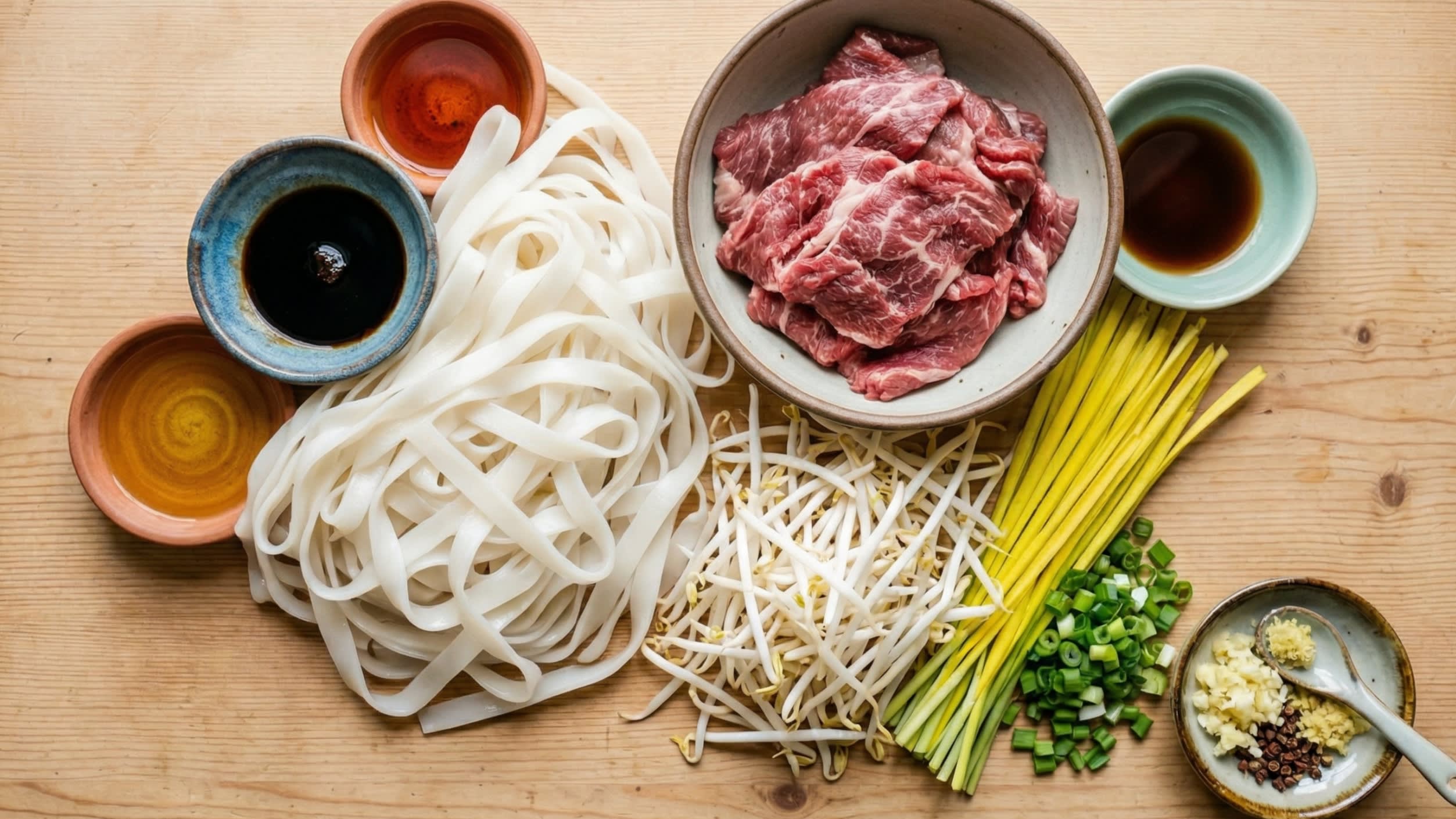
🛒 Ingredients List
The Beef & Velveting Marinade (上浆):
- 1/2 lb (225g) Flank Steak or Sirloin, sliced 1/4-inch thick against the grain.
- 1 tsp Light Soy Sauce
- 1 tsp Shaoxing Cooking Wine (绍兴酒)
- 1/2 tsp Cornstarch (玉米淀粉)
- 1/4 tsp Baking Soda (小苏打) - The secret to meltingly tender meat!
- 1 tbsp Water
- 1 tbsp Cooking Oil (to seal the moisture)
The Noodles & Vegetables:
- 1 lb (450g) Fresh Wide Rice Noodles (河粉 - Héfěn). If cold, microwave and separate by hand.
- 2 cups fresh Mung Bean Sprouts (绿豆芽 - Lǜdòuyá), rinsed and patted bone-dry.
- 1/2 cup Yellow Chives (韭黄 - Jiǔhuáng), cut into 2-inch sections. Traditional! If unavailable, extra green scallions work.
- 3 stalks Scallions (葱段), cut into 2-inch sections.
- 2 slices fresh Ginger, julienned.
- 1/2 White Onion, sliced thinly.
The Authentic Dry-Fry Sauce:
- 2 tbsp Light Soy Sauce (生抽)
- 1.5 tbsp Dark Soy Sauce (老抽 - Lǎochōu). Essential for that deep, glossy mahogany color!
- 1 tbsp Oyster Sauce (蚝油)
- 1/2 tsp Sugar
- 1/4 tsp White Pepper powder
🍳 Step-by-Step Instructions
1. Velvet the Beef (上浆): Place your beef slices in a bowl. Add the water, light soy sauce, Shaoxing wine, and baking soda. Massage the meat vigorously until the beef drinks up every drop of liquid. Mix in the cornstarch, then coat with a layer of oil. Let it rest for 15 minutes.
2. Mix the Sauce: Combine the light soy sauce, dark soy sauce, oyster sauce, sugar, and white pepper in a small bowl. Stir until the sugar is dissolved and set it aside near the stove.
3. Sear the Beef: Condition your wok (Run Guo). Heat 2 tablespoons of oil over high heat until smoking. Add the marinated beef in a single layer. Let it sear for 30 seconds before flipping. Cook until 80% done, then remove and set aside.
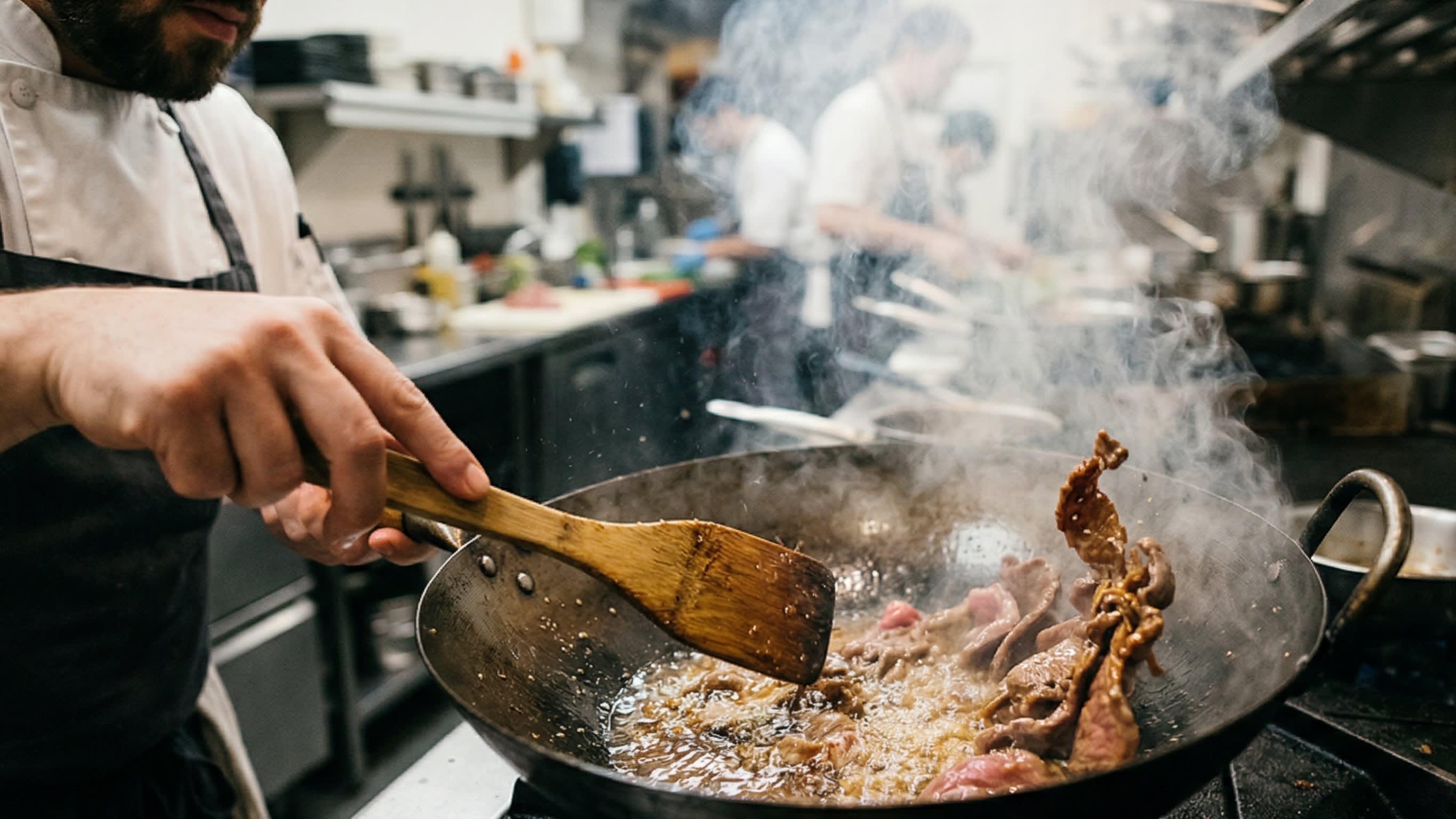
4. Blister the Aromatics: Wipe the wok clean. Add 1 tablespoon of fresh oil over high heat. Toss in the onions and ginger, stir-frying for 30 seconds until fragrant.
5. Sear the Noodles (The Critical Step): Add another tablespoon of oil. Lay your room-temperature rice noodles over the onions. Put down your spatula! If you chop the noodles, they will break. Let them sit for 20 seconds to develop a char. Use extra-long wooden cooking chopsticks to gently lift and toss from the bottom up.
6. Caramelize the Sauce: Pour the sauce over the noodles and toss vigorously. The extreme heat will cause the sauce to evaporate and glaze the noodles instantly.
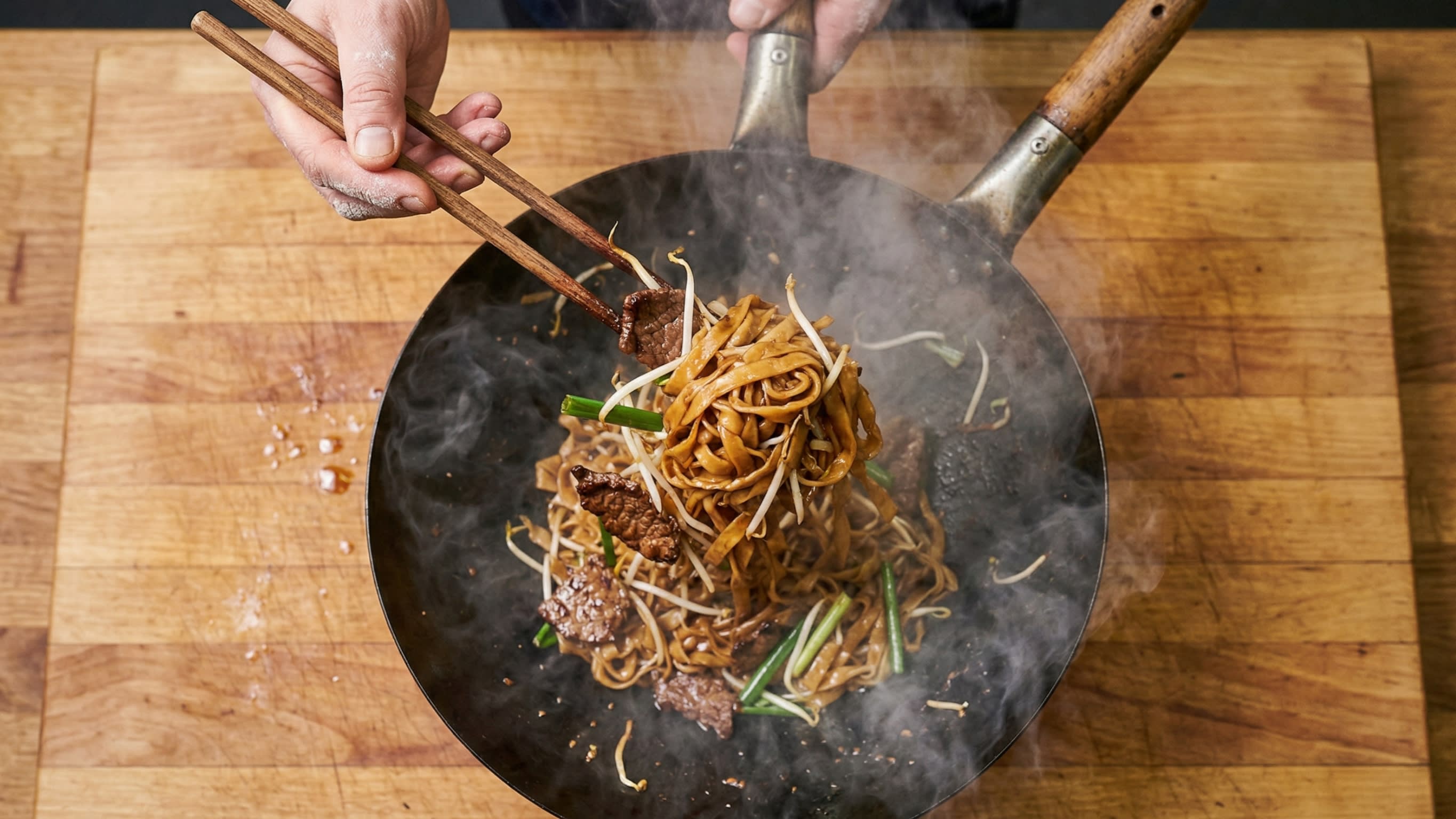
7. The Final Reunion (断生): Add the beef back in. Toss in the bean sprouts, yellow chives, and scallions. Stir over high heat for exactly 45 seconds to keep the sprouts crunchy (断生 - Duan Sheng).
8. Serve: Transfer to a plate and serve immediately.
📊 Summary of Cooking Techniques
| Technique | Purpose |
|---|---|
| Run Guo (润锅) | Creates a non-stick patina via extreme heat and oil conditioning. |
| Velveting (上浆) | Ensures meat stays tender by locking in moisture with starch and oil. |
| Duan Sheng (断生) | Rapidly cooking vegetables to keep them crisp, avoiding sogginess. |
For more techniques to level up your kitchen skills, check out my tips in Authentic Tomato and Egg Stir-Fry: China’s True National Dish. Beef Chow Fun is truly about the rhythm of the toss; once you feel that heat in your hands, you’ll never look at takeout the same way again. Happy cooking!
Disclaimer: As an Amazon Associate, ChinaCurator earns from qualifying purchases.