In our last article, we dispelled the myth that Chinese is impossibly hard and highlighted its surprising simplicity. Now, it’s time to roll up our sleeves and tackle the real challenges: tones, characters, and the cultural context that surrounds them.
This isn’t just theory. By the end of this article, you’ll have a clear, actionable strategy to overcome these hurdles and start your Chinese learning journey with confidence.
Part 1: Tones – Mastering the “Singing” of Chinese
Tones are the most distinctive—and often most feared—aspect of Chinese for English speakers. But with the right approach, they can be conquered.
The Four Tones of Mandarin
Mandarin has four main tones, each with a distinct pitch contour:
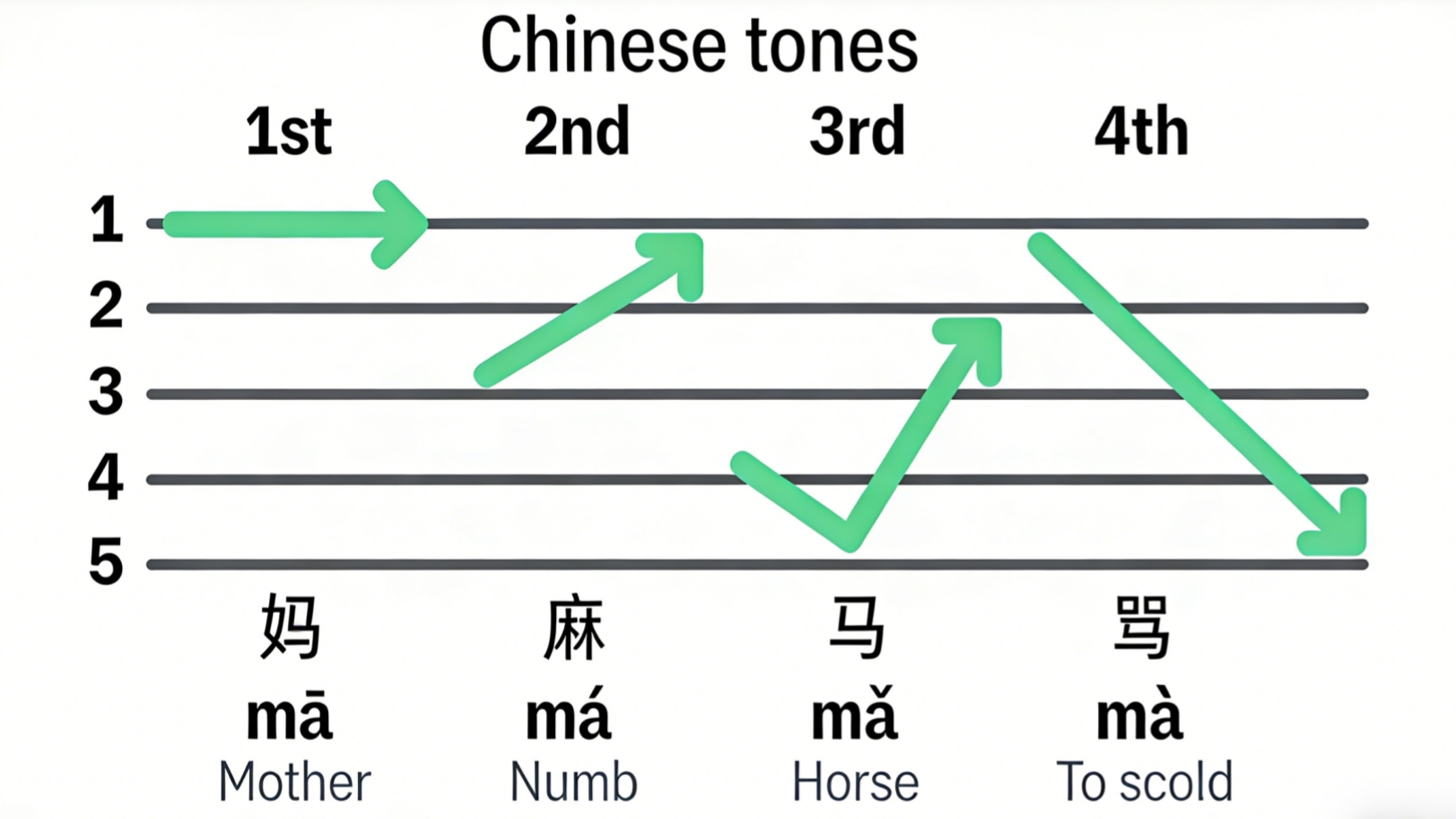
- First Tone (Flat): High and steady, like singing a single note.
- Example:
mā(妈) - mother - Mnemonic: Imagine drawing a straight line
¯.
- Example:
- Second Tone (Rising): Starts low and rises sharply, like asking a question.
- Example:
má(麻) - hemp - Mnemonic: Imagine drawing an upward curve
ˊ.
- Example:
- Third Tone (Falling-Rising): Starts low, dips lower, then rises. It’s the most complex.
- Example:
mǎ(马) - horse - Mnemonic: Imagine drawing a “V” shape
ˇ.
- Example:
- Fourth Tone (Falling): Starts high and falls quickly, like giving a command.
- Example:
mà(骂) - to scold - Mnemonic: Imagine drawing a downward line
ˋ.
- Example:
Actionable Strategies to Master Tones
- Use Visual Aids: Practice with a tone ladder (a graph of pitch over time) to visualize each tone. Many free apps like Pimsleur Chinese or Forvo have interactive tone practice.
- Shadowing Technique: Listen to short audio clips (try ChinesePod for free lessons) and repeat immediately, mimicking the tone as closely as possible.
- Minimal Pair Drills: Train your ear to distinguish words that differ only by tone. You can find free tone pair exercises on websites like AllSet Learning.
- Leverage Technology: Use apps with speech recognition, like HelloChinese, to get instant feedback on your tone accuracy.
Part 2: Characters – From “Mystery” to “Method”
The Chinese writing system is a work of art and logic. Once you understand its building blocks, memorization becomes systematic, not random.
The Building Blocks: Radicals and Strokes
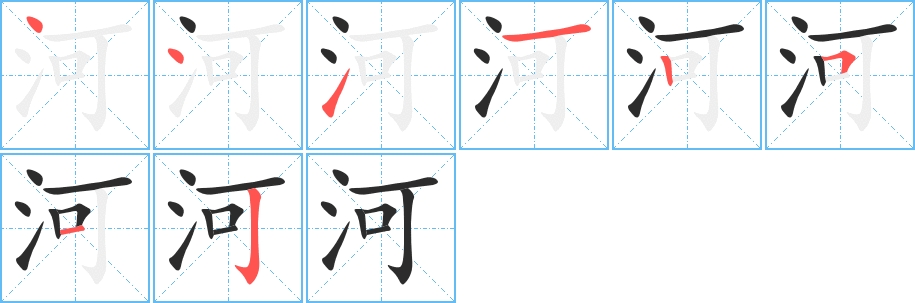
- Strokes: Every character is composed of a fixed number of basic strokes (e.g., horizontal, vertical, dot). Learning the correct stroke order is crucial for writing and helps with memorization.
- Radicals: Think of radicals as the “root words” or “偏旁部首 (piānpáng bùshǒu)”. They are recurring components that often give a clue to the character’s meaning or pronunciation.
- Example: The radical
氵(shuǐ, water) appears in characters like河(hé, river),湖(hú, lake), and海(hǎi, sea).
- Example: The radical
The Logic of Character Formation
Characters are formed in a few logical ways:

- Pictographs (Xiàngxíng): Directly resemble the object they represent.
- Example:
山(shān, mountain) looks like a mountain.
- Example:
- Associative Compounds (Huìyì): Combine two or more pictographs to create a new meaning.
- Example:
日(rì, sun) +月(yuè, moon) =明(míng, bright).
- Example:
- Phonetic-Semantic Compounds (Xíngshēng): The most common type. Combine a radical (for meaning) with a phonetic component (for sound).
- Example:
妈(mā, mother). The radical女(nǚ, female) indicates the meaning, and the component马(mǎ, horse) gives the pronunciation.
- Example:
Actionable Strategies to Learn Characters
- Start with the Most Common: Focus on the top 100 most frequently used characters first. You can find free lists on Wiktionary or apps like Anki (which has pre-made character decks).
- Use Spaced Repetition: Anki or Memrise are fantastic for this. They show you characters just before you forget them, maximizing retention.
- Learn in Context: Instead of memorizing isolated characters, learn them in words and sentences. Read short, simple articles on Chinese Text Project (with Pinyin and English translations).
- Write by Hand: Practice writing characters on paper or use a tablet app like Skritter (free version available) to reinforce muscle memory.
Part 3: Culture – The Invisible “Third Challenge”
Language and culture are inseparable. Understanding cultural context will prevent misunderstandings and make your language use more natural.
Key Cultural Nuances for Language Learners
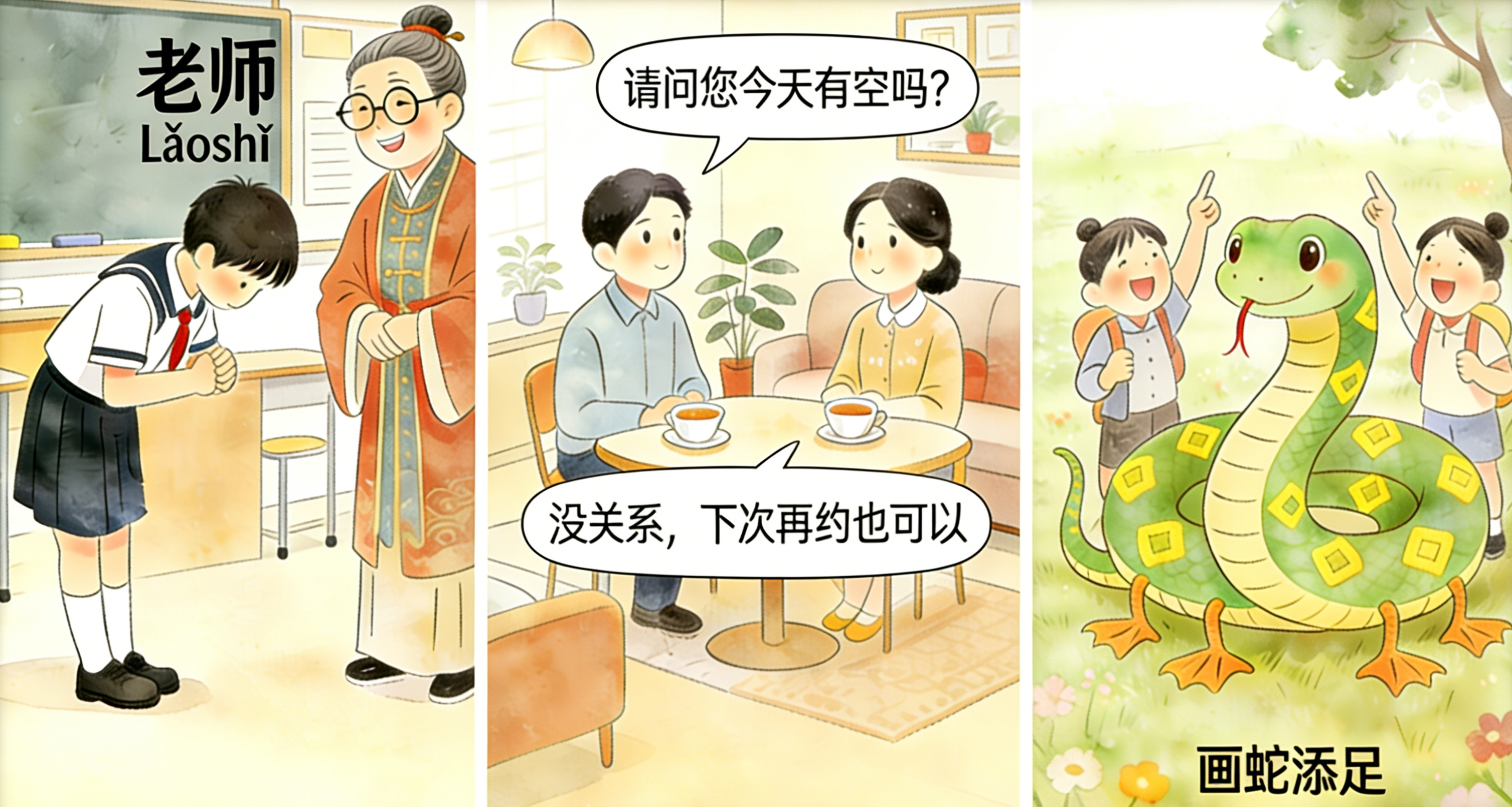
- Politeness and Hierarchy: Chinese has specific honorifics and ways of addressing people based on age, social status, and relationship. For example, you should address a teacher as
Lǎoshī(老师) instead of using their first name. - Indirect Communication: In many situations, especially when giving criticism or making requests, Chinese speakers tend to be more indirect to save face (
miànzi). - Idioms and Cultural References: Many Chinese expressions are rooted in history, mythology, or literature. For example,
画蛇添足(huà shé tiān zú, drawing a snake and adding feet) means “to do something unnecessary and ruin it.”
Actionable Strategies to Immerse in Culture
- Consume Media: Watch Chinese movies and TV shows on Netflix or iQiyi (with English subtitles at first, then switch to Chinese).
- Follow Chinese Trends: Explore social media platforms like Weibo (the Chinese Twitter) to see what’s trending, or follow Chinese cultural accounts on Instagram.
- Read About History: A basic understanding of Chinese history (e.g., the Dynasties, Confucianism) will enrich your understanding of the language. You can find free courses on Coursera.
Conclusion: From Fear to Confidence
We’ve taken a deep dive into the three pillars of Chinese learning: tones, characters, and culture.
- Tones are not random; they are a musical system that can be trained with practice.
- Characters are not just pictures; they are a logical system built from radicals and components.
- Culture is not an extra; it’s the context that gives language life and meaning.
By breaking these challenges down into manageable parts and using the strategies provided, you can transform your initial fear into confidence.
The next step is to understand why you should embark on this journey. In our next article, “Why Learn Chinese? Beyond ‘The Language of the Future’”, we’ll explore the countless personal, professional, and cognitive benefits that await you.